

ITALIAN FILM FESTIVAL
In the Mirror (Mi Fanno Male i Capelli)
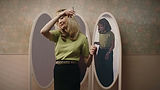
Monica, adrift in the fog of a memory disorder, begins blurring her life with the screen personas of iconic Italian actress Monica Vitti. As her sense of self frays, she retreats into cinematic fantasies shaped by Vitti’s films, while her husband lovingly plays along, unsure whether he’s protecting her or losing her. A haunting, poetic portrait of identity dissolving into myth, set against the hushed coastline and echoes of Italian cinema’s golden years.
Director
Roberta Torre
Actors
Alba Rohrwacher • Filippo Timi
1h 23m • Rated M • Drama • Italy (2023) • Eng Subtitles

The island setting, the modest production, and the humor that often arises from character rather than contrivance work together to keep the film from ever feeling flat. On the flip side, a few feel the pacing is uneven, or that the secondary characters don’t always land. Still, even these criticisms tend to be soft and in the service of a film that is more heartwarming than perfect.
Overall, the consensus sees The Ballad of Wallis Island as a warm, wistful, and soul-soothing film—modest in scope but rich in feeling. It’s not trying to dazzle, but it digs in where it matters: loss, memory, music, human connection. For many, it’s one of the more emotionally satisfying films of 2025.
The Ballad of Wallis Island is a quietly charming British comedy-drama directed by James Griffiths, written by and starring Tom Basden and Tim Key, alongside Carey Mulligan. The story centers on Charles, a lonely lottery winner living on a remote Welsh island, who invites his favorite folk duo—Herb McGwyer and Nell Mortimer—to reunite for a private performance. His motive isn’t just fandom; there are unresolved heartbreaks, nostalgia, and grief behind his idealistic gesture.
Critics are largely enamored with the film’s balance of humor and melancholy. Tim Key’s performance as Charles is praised for being endearingly awkward, verbose, and heart-on-sleeve, often using verbal wit to stave off silence. Basden as Herb, and Mulligan as Nell, deliver subtle, emotionally resonant performances, especially when the old romantic and artistic tensions surface—and you begin to feel what’s been lost, as well as what hope might remain. The original music is another highlight; the songs feel lived in, and the film uses them not as spectacle, but as emotional anchors.
Some reviewers point out that the premise is familiar—a fan’s devotee, reunited artists, romantic regrets—but argue that the execution elevates it.

CRITICS ROUNDUP
BOOK SEATS FOR
In the Mirror (Mi Fanno Male i Capelli)
Tue 6 Jan 5:00pm ncp
52 seats left
All tickets must be prepaid online or at the counter.
Sales are subject to our cancellation policy. No phone bookings
ncp - no complimentary passes
cap - captioned for hard of hearing

The make-believe effect is achieved by the exceptional work of costume designer Massimo Cantini Parrini and music score by Shigeru Umebayashi — who is none other than the composer for In The Mood For Love. Mi fanno male i capelli is the original name of the film, that would translate to “My Hair Hurts”. This is one of Monica Vitti’s famous lines from the film Il Deserto Rosso (Red Desert), that was awarded the Golden Lion at the Venice Film Festival in 1964.
Critics Roundup
Dreamlike, melancholic, cine-obsessed elegy
Director Roberta Torre, inscribes on reel, her love letter towards the esteemed Italian actress Monica Vitti. However, In the Mirror is not a biopic, it’s much better. Monica (Alba Rohrwacher) suffers from the Korsakoff syndrome that affects her memory while at the same time creating false memories. This premise provides an eerie parallel with Monica Vitti’s last years when she was affected by Lewy body dementia. The Monica in Roberta Torre’s film gradually gets swept into a state of confusion as she watches the films of Michelangelo Antonioni’s muse. Meanwhile, her husband Edoardo (Filippo Timi), indulges in her visions whilst they reside in their house by the sea